

Wine E-Label: The Complete Guide to EU Digital Wine Labelling
Everything you need to know about EU wine e-label compliance — from regulation basics to QR code specs, ingredient lists, nutrition tables, language requirements, and Italian-specific rules. Written for winery owners, not lawyers.
In this guide
This guide is for informational purposes only and does not constitute legal advice. Regulations may change — always verify requirements with your local authority or legal counsel.
01What Is a Wine E-Label?
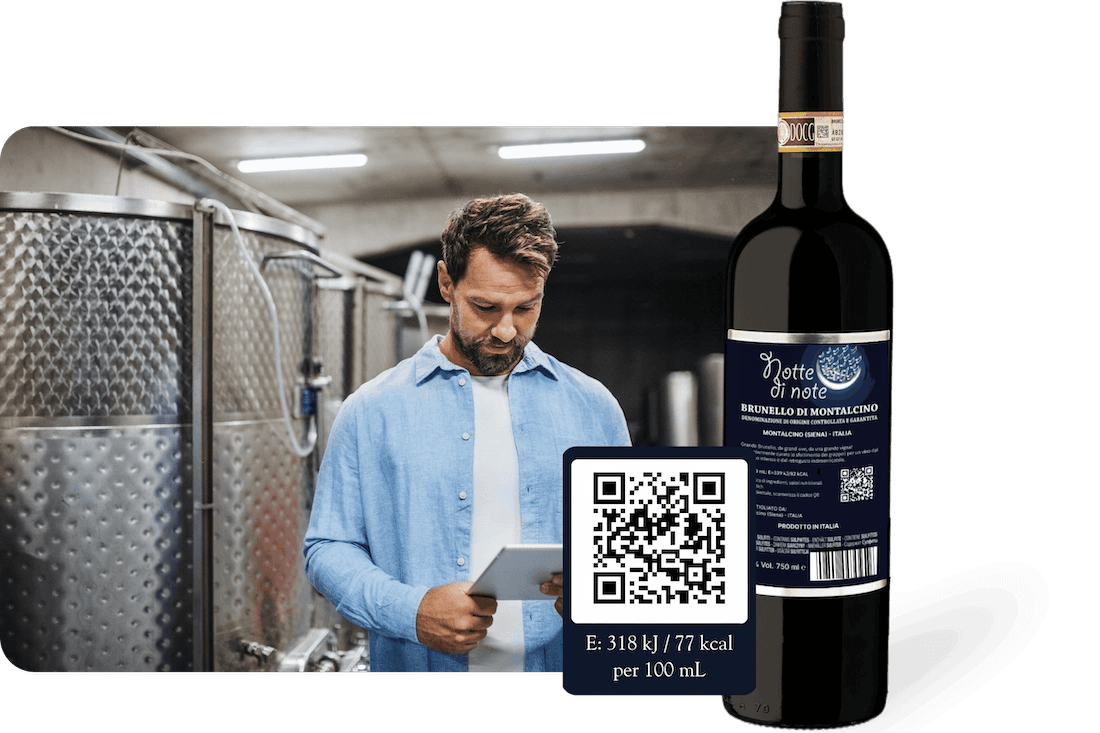
A wine e-label is a digital label accessed via a QR code on the wine bottle. It provides EU-mandated information — including a full ingredient list and nutritional declaration — that consumers can view on their smartphone. Under EU Regulation 2021/2117, all wines produced from 8 December 2023 onwards must disclose nutritional information and ingredients to consumers. While this can be printed on the physical label, the e-label is the most practical and widely adopted solution.
Think of an e-label as an extension of your physical wine label. The EU decided that wine bottles, like food products, must disclose their ingredients and nutritional values. Because wine labels are already crowded with mandatory information (appellation, alcohol content, allergens, bottler details), the regulation allows producers to provide the ingredient list and nutrition table digitally — through a QR code that links to a dedicated web page.
When a consumer scans the QR code on your bottle, they are taken directly to a clean, mobile-friendly page showing exactly what is in the wine and its nutritional profile. No app is needed — any smartphone camera works. The page must be free of marketing, tracking, and sales content. It is purely factual, purely informational.
The legal framework
EU Regulation 2021/2117 amended the Common Market Organisation regulation (1308/2013) to require ingredient and nutritional declarations on wine for the first time. The detailed rules for how e-labels must work are set out in Commission Delegated Regulation 2023/1606 and Commission Implementing Regulation 2023/1607.
02Which Wines Must Disclose Ingredients and Nutrition?
All wines produced and placed on the EU market from 8 December 2023 onwards must provide a full ingredient list and nutritional declaration to consumers. This includes still, sparkling, fortified, and aromatised wines — regardless of the producer's size. While this information can appear on the physical label, e-labels via QR codes are the most practical way to comply. Wines bottled before this date are exempt and may be sold until stocks run out.
The regulation applies broadly. Whether you produce 500 bottles or 5 million, whether you sell domestically or export across 20 EU countries, the rules are the same. There is no small-producer exemption.
- All still wines (red, white, rosé) produced from December 2023 onwards
- Sparkling wines, including Prosecco, Champagne, Cava, and Crémant
- Fortified wines such as Port, Sherry, and Marsala
- Aromatised wine products like Vermouth
Transitional rules: what about older vintages?
Wines that were produced before 8 December 2023 are grandfathered in — in regulatory terms, 'produced' means the wine had completed its winemaking process (achieved the required alcoholic strength and acidity for still wines, or completed second fermentation for sparkling wines) and was bottled and labelled before that date. These wines can continue to be sold without an e-label until stocks are exhausted. In practice, this means wines from the 2023 vintage and earlier are generally covered. However, all wines from the 2024 harvest onwards should carry compliant e-labels.
The practical cutoff is wines from the 2024 vintage onwards. If you are bottling a 2024 or later vintage, you need an e-label.
03What Must Appear on a Wine Label vs. the E-Label?
The physical bottle label must show allergens, energy value, alcohol percentage, bottler information, net content, and lot number. The full ingredient list and complete nutritional declaration (seven nutrients) may be provided digitally through the e-label QR code instead of on the physical label.
| Physical Label | E-Label (QR Code) | |
|---|---|---|
| Allergens | Required (in all market languages) | Also listed on e-label |
| Energy value (kJ/kcal) | Required (with 'E' symbol) | Included in full nutrition table |
| Product category | Required | Optional |
| Alcohol by volume (%) | Required | Optional |
| Bottler / producer name | Required | Optional |
| Net content | Required | Optional |
| Lot number | Required | Optional |
| Full ingredient list | Optional (may use QR instead) | Required |
| Full nutritional declaration | Optional (may use QR instead) | Required (all 7 nutrients) |
| Recycling information | Optional | Optional (mandatory for Italy) |
The key benefit of e-labels is that they free up space on the physical label. Instead of cramming ingredients and a full nutrition table onto the bottle, you provide them digitally. The physical label still carries allergens and energy value — the most critical safety information.
04What Ingredients Must Be Listed on a Wine E-Label?
Wine e-labels must list all ingredients in descending order by quantity, starting with 'Grapes' as the primary ingredient. Additives must be grouped by functional category — acid regulators, preservatives, stabilisers, and gases. Allergens (sulphites, milk and egg derivatives) must be highlighted in bold.
The ingredient list is one of the two core pieces of information that e-labels exist to provide. The rules follow the same general principles as food labelling, but with wine-specific adaptations. Here is what you need to know.
The ingredient list must be headed with the word 'Ingredients' — not 'Contents', not 'What's inside', but specifically 'Ingredients'.
'Grapes' must always appear first as the primary ingredient, regardless of the exact percentage. After grapes, additives are listed in descending order by quantity used.
Allergens must be visually highlighted — bold text is the recommended approach. The three key allergens in wine are: sulphites (must be declared above 10 mg/L), milk-derived products, and egg-derived products (both must be declared above 0.25 mg/L).
Ingredients that represent less than 2% of the final product may be listed at the end in any order, rather than strictly by quantity.
Mandatory functional categories for additives
Processing aids vs. ingredients: an important distinction
Processing aids are substances used during winemaking but removed before bottling — like bentonite for fining or diatomaceous earth for filtration. These generally do not need to be listed. However, there is one critical exception: allergenic processing aids derived from milk or egg must still be declared if they are detectable in the final wine (above 0.25 mg/L).
All text on the e-label must use a minimum font size of 1.2 mm x-height for legibility.
05What Nutritional Information Is Required for Wine?
Wine e-labels must display a table of seven nutrients per 100 ml: energy (in kJ and kcal), fat, saturated fat, carbohydrates, sugars, protein, and salt. These values are calculated from the wine's alcohol content, residual sugar, acidity, and glycerin levels. Energy value must also appear on the physical label.
The nutritional declaration follows the same format as food products. You present a table (tabular format is preferred, though a linear format is also accepted) showing each nutrient per 100 ml of wine. Values may be averages based on analysis or calculation — you do not need a laboratory test for every single bottle.
| Nutrient | Unit | Notes |
|---|---|---|
| Energy | kJ / kcal | Must also appear on physical label using 'E' symbol |
| Fat | g | Usually negligible in wine — 'trace amounts' notation allowed |
| Saturated fat | g | Usually negligible — 'trace amounts' notation allowed |
| Carbohydrates | g | Driven primarily by residual sugar content |
| Sugars | g | A subset of carbohydrates; varies significantly by wine style |
| Protein | g | Usually negligible — 'trace amounts' notation allowed |
| Salt | g | Usually negligible — 'trace amounts' notation allowed |
Nutritional values for wine are calculated from four key parameters: alcohol content, residual sugar, acidity, and glycerin. A good e-label platform will calculate these automatically from your lab analysis data — you should not need a nutritionist.
The regulation allows nutritional values to be stated as averages. Reasonable tolerance is built into the system, recognising that natural products like wine vary from batch to batch.
The preferred format is a table, but a linear text format is also acceptable. For example: 'Energy: 350 kJ / 84 kcal, Fat: <0.5 g, Saturated fat: <0.5 g, Carbohydrates: 2.5 g, Sugars: 1.0 g, Protein: <0.5 g, Salt: <0.5 g'.
06What Languages Must a Wine E-Label Be In?
The e-label must display information in the official language of every EU country where the wine is sold. There are 24 official EU languages, and each member state can require its own. English alone is never sufficient — Italy, for example, specifically rejects English-only e-labels.
Language compliance is one of the biggest practical challenges for wineries that sell across multiple EU markets. The rule is straightforward: if you sell wine in a country, your e-label must be available in that country's official language. There is no universal language exemption.
A winery selling to Italy, France, Germany, and the Netherlands needs its e-label in at least four languages: Italian, French, German, and Dutch. For Belgium alone, you may need both French and Dutch (or German, depending on the region). Multiply this across all your export markets and the translation burden adds up quickly.
| Market | Required Language(s) |
|---|---|
| Italy | Italian |
| France | French |
| Germany / Austria | German |
| Spain | Spanish |
| Portugal | Portuguese |
| Netherlands | Dutch |
| Belgium | French, Dutch, or German (region-dependent) |
| Switzerland (non-EU) | German, French, and/or Italian (region-dependent). Note: Switzerland is not an EU member but a key export market with its own labelling rules. |
Important
English alone is NOT sufficient for any EU market. Italy specifically does not accept English as a substitute for Italian. Each country requires its own official language(s). Using only English — even for 'international' wines — is a compliance violation.
07What Are the QR Code Requirements for Wine Labels?
Wine e-label QR codes must be at least 1 cm × 1 cm in the EU (1.5 cm × 1.5 cm in Italy). Each wine needs its own unique QR code — codes cannot be shared across products. The QR must be printed on the back label, clearly visible, and accompanied by text containing the word 'Ingredients'.
Technical specifications
- The absolute EU minimum is 1 cm × 1 cm, but the Commission Notice (C/2023/1190) and industry guidance recommend at least 1.3 cm × 1.3 cm for reliable scanning. We recommend 1.5 cm × 1.5 cm as your standard — already in line with Italy's requirement and ensures readability across all printing conditions.
- Italy requires a minimum of 1.5 cm × 1.5 cm — larger than the EU default. If you sell in Italy, use the Italian minimum as your standard.
- Each wine product must have its own individual QR code. You cannot use a single QR code for multiple wines, even within the same range. Each product/vintage/batch needs a dedicated code linking to its specific e-label.
- Download QR codes in print-ready formats: SVG, EPS, and PDF for vector quality, or PNG and WebP for digital use. Share the file directly with your label printer.
Physical label placement rules
- The QR code must appear on the back label (or the main label if only one label is used)
- It must be conspicuous, easily visible, clearly legible, and indelible
- It must not be hidden, obscured, or interrupted by other printed matter or imagery
- It must be accompanied by a heading text that contains the word 'Ingredients' — the 'i' symbol alone is not sufficient
How long must the QR code stay active?
Your e-label must remain accessible online for as long as the wine may reasonably be expected to remain fit for consumption (Delegated Regulation 2023/1606). The regulation does not specify fixed year ranges — in practice, this means a few years for young, everyday wines and 10 or more years for age-worthy wines. The widely adopted industry standard is 10 years from market entry. This means your hosting provider must guarantee long-term availability — a key factor when choosing an e-label platform.
08What Can and Cannot Appear on a Wine E-Label Landing Page?
The e-label landing page must contain only factual, mandatory information — ingredients, nutrition, and allergens. It is strictly prohibited to include marketing content, product descriptions, sales links, social media links, cookies, tracking pixels, analytics tools, or login requirements. The page must be mobile-responsive with direct access.
This is where many producers get caught out. The e-label page is not a marketing opportunity — the EU has made this crystal clear. When a consumer scans your QR code, they must arrive at a clean, factual page with zero commercial content. Think of it as a regulated information sheet, not a product page.
Prohibited on the e-label page
- Marketing content — no awards, medals, tasting notes, or winery stories
- Sales or purchase functionality — no 'Buy Now' buttons or shop links
- Links to the producer's commercial website
- Social media links or sharing buttons
- Cookies of any kind (including 'functional' cookies)
- Tracking pixels from advertising or analytics platforms
- Analytics tools such as Google Analytics, Meta Pixel, or similar tracking services
- Login or registration requirements — access must be immediate and anonymous
Required on the e-label page
- Factual, mandatory information only — ingredients, nutrition, allergens
- GDPR-compliant legal notices (privacy policy link)
- Mobile-responsive design that works on any smartphone
- Direct access — no intermediate pages, no redirects to a homepage, no pop-ups
09What Are the Rules for Italy? (ICQRF, Sanctions, Recycling)
Italy has stricter e-label rules than the general EU standard. QR codes must be at least 1.5 cm × 1.5 cm. E-labels must be in Italian — English is not accepted as a substitute. Non-compliance carries fines of €250 to €5,000 under Legge 238/2016. Italy also requires separate recycling label information under D.Lgs. 116/2020.
Italy is the world's largest wine producer, with approximately 44 million hectoliters produced in 2025 and a highly fragmented industry of thousands of small, family-run wineries. Because of its central role in the EU wine market, Italy has implemented some of the strictest interpretations of the e-label regulation. If you sell wine in Italy, you need to know these rules.
Who enforces e-label compliance in Italy?
The ICQRF (Ispettorato Centrale della Tutela della Qualità e della Repressione Frodi dei Prodotti Agroalimentari), operating under the Ministry of Agriculture, is the primary enforcement body. They establish national application rules, conduct official inspections, and impose sanctions on non-compliant producers.
What are the fines for non-compliance?
Under Legge 238/2016, Article 74, Comma 1, non-compliance with wine labelling rules carries an administrative fine of €250 to €5,000 per infringement. In more serious cases, authorities can order a sales stop on the non-compliant batch or even a full product recall.
Italy mandates a minimum QR code size of 1.5 cm × 1.5 cm — 50% larger than the EU general minimum of 1 cm × 1 cm. If you produce labels for the Italian market, make sure your design allows for this larger size.
Italy does not accept English as a substitute for Italian. All mandatory e-label information for wines sold in Italy must be in Italian. This is non-negotiable and is one of the most commonly cited compliance failures for imported wines.
Italian recycling label requirements (D.Lgs. 116/2020)
In addition to e-label compliance, Italy requires environmental labelling under D.Lgs. 116/2020. This means providing material identification codes and disposal instructions for each packaging component (bottle, cap, label, etc.). While this is a separate obligation from the e-label, many wineries choose to include recycling information on the same QR code landing page — which is permitted under the regulation.
10How Do I Create a Wine E-Label? (Step by Step)
Creating a wine e-label involves five steps: gather your wine data (lab analysis, ingredients, allergens, target markets), enter the information in an e-label platform, review and publish the e-label, download the QR code for your printer, and test the final result by scanning it. The entire process takes minutes with the right tool.
Here is a practical, step-by-step walkthrough of the e-label creation process. While the exact interface varies by platform, these are the universal steps every winery needs to follow.
Gather your wine data
Before you start, you will need: your wine analysis report (alcohol content, residual sugar, acidity, glycerin), a list of all additives used during winemaking, confirmation of any allergens present (sulphites, milk or egg derivatives), and the list of EU markets where you plan to sell. If you work with an oenologist, they will have most of this data already.
Enter information in your e-label platform
Select your ingredients from a pre-built database (a good platform will have all standard wine additives pre-translated into 24 languages). Enter your lab analysis values and let the platform calculate nutritional values automatically. Specify your target markets to activate the correct language translations. Add allergen declarations.
Review and publish your e-label
Preview the e-label exactly as consumers will see it. Check that all translations look correct, all nutritional values are reasonable, and allergens are properly highlighted in bold. Once you are satisfied, publish the e-label to make it live.
Download and print your QR code
Download the QR code in your preferred print format — SVG or PDF for the best print quality, PNG for digital use. Share the file with your label printer or packaging designer. Remember: the QR code must be at least 1 cm × 1 cm (1.5 cm × 1.5 cm for Italy) and must appear alongside the word 'Ingredients'.
Test and verify compliance
Scan the printed QR code with your smartphone to make sure it works. Check that the landing page loads quickly, displays all the correct information, shows the right languages for your target markets, and that allergens are properly highlighted. Test on both iOS and Android devices. This final check takes two minutes and can save you from costly compliance issues.
11What Are the Most Common E-Label Compliance Mistakes?
The most common e-label mistakes are: using only English instead of local languages, including marketing content on the e-label page, using a QR code that is too small for Italy, having tracking or analytics on the landing page, sharing one QR code across multiple wines, and failing to keep e-labels online for the required retention period.
Using English as a universal language
Many producers assume English is sufficient for all EU markets. It is not. Italy specifically rejects English-only e-labels, and every member state requires information in its official language(s). If you sell in five countries, you need five languages at minimum.
Adding marketing content to the e-label page
The temptation to include awards, tasting notes, or a 'Shop Now' button is understandable — but it is explicitly prohibited. The e-label page must contain only mandatory factual information. Even links to your website are not allowed.
QR code too small for the Italian market
Italy requires a minimum QR code size of 1.5 cm × 1.5 cm, which is 50% larger than the EU default. Producers who design labels to the EU minimum of 1 cm and then ship to Italy are technically non-compliant. Design for the Italian size from the start.
Using analytics or tracking on the landing page
Google Analytics, Meta Pixel, and similar tracking tools are prohibited on e-label pages. The regulation explicitly bans cookies, tracking pixels, IP address storage, and device fingerprinting. Your e-label hosting must be completely tracking-free.
Sharing one QR code across multiple wines
Each wine product needs its own individual QR code linking to its specific ingredient and nutritional data. You cannot use a single QR code for your entire range, even if the ingredients are identical. Each product, vintage, and batch requires a dedicated code.
Failing to maintain e-labels long-term
E-labels must remain accessible online for up to 10 years from market entry. If your hosting provider goes offline, changes its terms, or you switch platforms without migrating your data, consumers scanning old bottles will hit a dead link — and you will be non-compliant for every bottle still in circulation.
12What Changed in 2026? (EU Regulation 2026/471)
In February 2026, the EU Council approved Regulation 2026/471 with new wine sector measures effective from 18 March 2026. Key changes include standardised de-alcoholised wine terms, authority for pictograms on labels, an export exemption from EU labelling rules, and simplification of cross-border label requirements. Core e-label obligations remain unchanged.
On 24 February 2026, the EU Council adopted Regulation 2026/471, a sweeping set of measures to support the wine sector. The regulation enters into force on 18 March 2026 — twenty days after publication in the Official Journal. While it introduces several important changes, the core e-label requirements from Regulation 2021/2117 remain fully in effect.
Standardised de-alcoholised wine terms
The regulation introduces clear definitions: 'Alcohol-free' for wines below 0.5% ABV, '0.0%' for wines below 0.05% ABV, and 'Reduced-alcohol' for wines at least 30% lower than standard strength. This replaces earlier proposals that used the term 'alcohol-light'. De-alcoholised wines under 10% ABV must also show a minimum durability date.
Authority for pictograms on labels
The regulation gives the Commission authority to develop pictograms that can supplement or partly replace text on wine labels. This aims to make labels more consumer-friendly and reduce the visual burden of multi-language requirements, though the specific pictograms have not yet been finalised.
Export exemption from EU labelling
Wines destined exclusively for export outside the EU are now exempt from the requirement to list ingredients and provide nutrition declarations for the EU market. This reduces the compliance burden for producers focused on non-EU markets like the USA, UK, or Asia.
Labelling simplification and harmonisation
The reform includes measures to simplify and harmonise labelling rules across the EU, aiming to reduce administrative costs and facilitate cross-border trade. This is particularly relevant for small producers who sell in multiple member states.
The core e-label obligations — ingredients, nutrition, QR code, language requirements, no-marketing rules — are unchanged by the 2026 reform. If you are already compliant with Regulation 2021/2117, you remain compliant. The 2026 changes are additions and clarifications, not replacements.
13Frequently Asked Questions
Do I need a separate QR code for each wine?
Yes. Each wine product must have its own individual QR code linking to its specific ingredient list and nutritional declaration. You cannot share a single QR code across different wines, even if their compositions are similar. Each product, vintage, and batch requires a dedicated code.
Can I use one QR code for multiple vintages of the same wine?
Generally, no — because nutritional values differ between vintages due to variations in sugar content, alcohol, and acidity. Each vintage has unique lab values that produce different nutritional declarations. Some platforms offer dynamic QR codes that can be updated when a new vintage is released, which keeps the same printed QR but changes the underlying data.
Is Google Analytics allowed on wine e-labels?
No. Google Analytics, Meta Pixel, and any other tracking or analytics tools are explicitly prohibited on e-label landing pages. The regulation bans all forms of user tracking, including cookies, tracking pixels, IP address storage, and device fingerprinting. Your e-label page must be completely tracking-free.
Do imported wines need EU e-labels?
Yes, if they are sold on the EU market. Any wine placed on the EU market from 8 December 2023 onwards — whether produced in the EU or imported — must provide ingredient and nutritional information to consumers. If the producer chooses to use an e-label (the most common approach), it must meet all the same requirements. The importer or EU representative is responsible for ensuring compliance. However, wines destined solely for export outside the EU are now exempt under the 2026 reform.
How do I calculate nutritional values for wine?
Wine nutritional values are calculated from four key parameters in your lab analysis: alcohol content, residual sugar, acidity, and glycerin. A formula converts these into energy (kJ/kcal), carbohydrates, sugars, and other nutrients. Most e-label platforms, including QRFox, have built-in calculators that do this automatically from your lab data.
What is the difference between processing aids and ingredients?
Ingredients are substances present in the final wine (grapes, sulphur dioxide, tartaric acid, etc.) and must be listed. Processing aids are used during winemaking but removed before bottling (bentonite, diatomaceous earth, etc.) and generally do not need to be declared. The critical exception: allergenic processing aids from milk or egg must be declared if detectable above 0.25 mg/L.
Do organic wines have different e-label requirements?
The e-label requirements are the same for organic and conventional wines. Organic wines must list the same seven nutrients and declare all ingredients in the same format. The organic certification status can appear on the physical label as usual, but the e-label content requirements are identical.
How long must e-label content remain available online?
E-labels must remain accessible for as long as the wine may reasonably be expected to remain fit for consumption. The regulation does not specify fixed year ranges — in practice, this means a few years for young wines and 10 or more years for age-worthy wines. The widely adopted industry standard is 10 years from market entry. Choosing a reliable e-label platform with long-term hosting guarantees is essential.
What does the 2026 EU wine reform change for e-labels?
The February 2026 reform (Regulation 2026/471) adds standardised de-alcoholised wine terms, authorises pictograms, and exempts export-only wines from EU labelling. Crucially, the core e-label obligations — ingredients, nutrition, QR codes, language requirements, and no-marketing rules — remain completely unchanged.
How much does wine e-label compliance cost?
E-label platform costs vary, but plans typically start from around €90 per year for small producers. This covers e-label creation, QR code generation, multi-language translations, and long-term hosting. The cost is modest compared to potential fines (€250–€5,000 per infringement in Italy) and the cost of reprinting labels. Most platforms offer free trials so you can test before committing.
Plans from €90/year
Start for free. Your first e-labels are ready in minutes.
Get the One-Page Compliance Checklist
A printable A4 checklist you can pin in the cellar. Every requirement at a glance — physical label, e-label, QR code specs, Italian rules — with checkboxes to tick off as you go.