Calculate Calories in Wine
Whether you're a wine enthusiast or just looking to make healthier choices, understanding the caloric content of your favorite wine is a valuable piece of information. Calories in wine and other drinks can come from sugar content – depending on the style – but alcohol itself is a major contributor.
‘If you are looking to limit your calorie intake, you are right to focus on the alcohol content of wine, as this is by far the most significant determinant of its calorific content,’ wrote Beverley Blanning MW in response to a Decanter reader query in 2016.
Definition of Calories
To begin, let's clarify what calories are and why they matter. Calories are units of energy found in food and beverages.
Knowing the calorie count of the food and drinks we enjoy helps us make informed choices about our nutrition.
Before we dive into calorie calculations, it's essential to understand the composition of wine. Wine consists of water, alcohol, sugar, and other compounds.
Factors Affecting Wine Calories: Alcohol content, Residual Sugar and Serving Size
One of the primary factors influencing wine calories is the alcohol content. Higher alcohol percentages contribute more calories per serving. Sweetness in wine comes from residual sugars, that also influence the calories. Last but not least, the amount plays also an important role in counting the calories in the wine consuption. Manzanilla, a dry Sherry, is a fortified wine with a higher calorie content due to its alcohol concentration. However, since it is typically consumed in smaller quantities, the overall calorie intake may be lower compared to an unfortified wine with lower alcohol content.
There are established formulas for estimating wine calories based on alcohol content, sugar levels and organic acids. The calculation used by QRFox.eu is based on caloric values of 7 Kcal/g for alcohol, 4 Kcal/g for sugar, and 3 Kcal/g for organic acids. For precise results, we always recommend consulting the laboratory findings and once you have this information it can be used as long as the core of the product remain unchanged for the future vintages.
The Calories of White Wine, Red Wine, and Sparkling Wine
Considering that, generally, red wine has a higher alcohol content compared to white wine, we can say that it tends to have a higher calorie content. The same applies to sweet dessert wines, which have a higher alcohol content and a significant sugar residue, resulting in a higher calorie content compared to classic red or white wines.
A separate category includes sparkling wines. How many calories do they have? It largely depends on their sugar residue. Dry sparkling wines (pas dosé, extra brut, brut), which have a low sugar residue, are less calorific than sweet sparkling wines (extra dry, dry, demi-sec, and sweet).
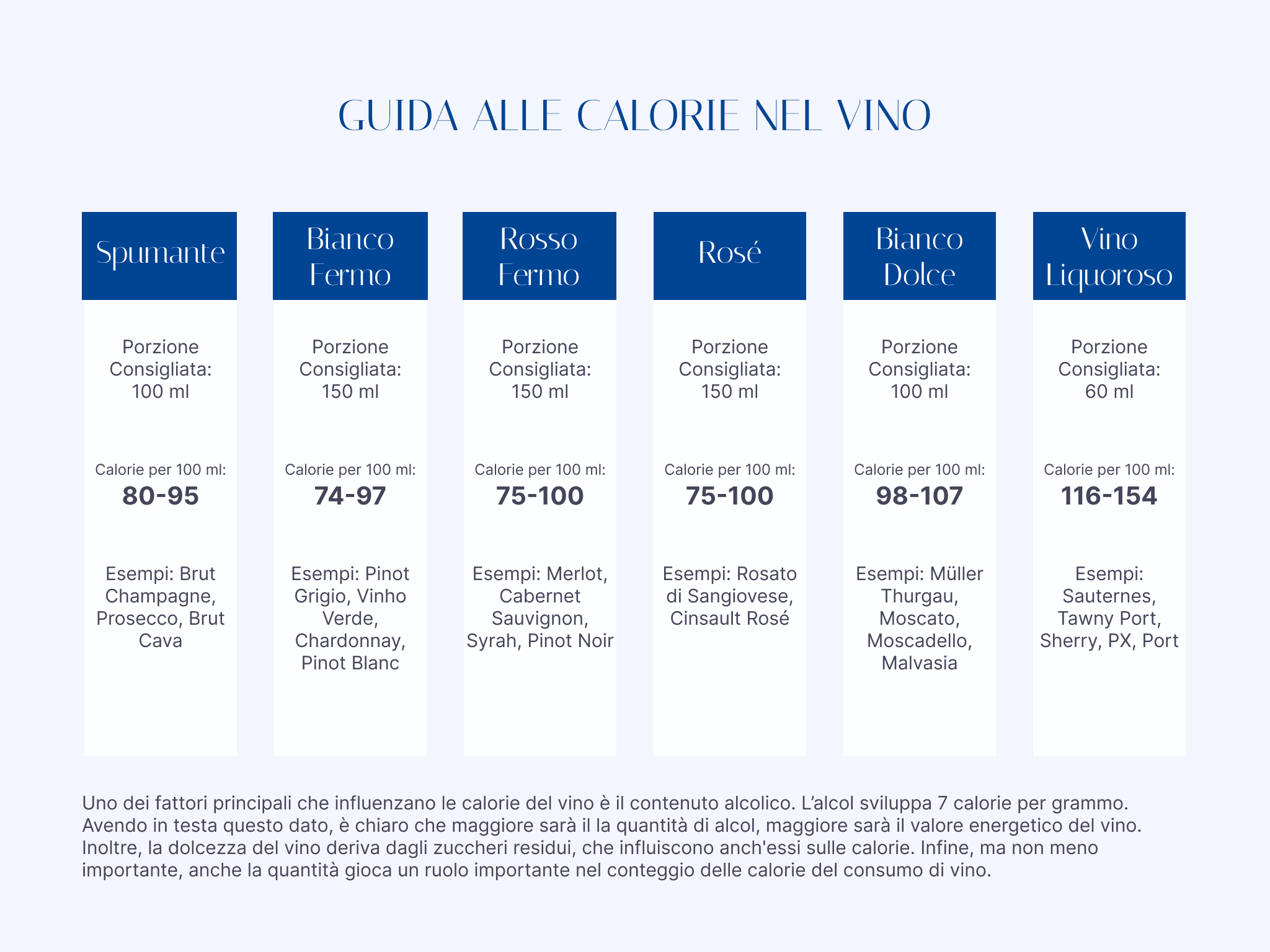
Without calculating the precise calories of the glass of wine we want to drink, we can still consider that, on average, a 150 ml glass of wine has the following values:
- The calories of red wine range from 80 to 130, depending on the alcohol content (usually between 10 and 15 degrees).
- The calories of white wine range from 80 to 110, depending on the alcohol content (10-13).
- The calories of sparkling wine range from 80 to 150, based on the alcohol content (11-12.5) and, above all, the sugar content.
However, let's not be alarmed by these numbers! Enjoying one or, why not, a couple of glasses of wine with meals is not only a pleasure but also beneficial! As with anything, the key is not to overindulge...
There are many tools to calculate them online. Check them for inspiration but a we recommend always to check with the proper analysis at least for the very first time.
How does QRFox.eu handle energy calculation?
There are three options to obtain this information. The first is to conduct typical wine analysis. As a second option, based on the wine type and its alcohol content, using generally accepted data is also possible. The third option is to utilize existing data.
QRFox.eu provides an internal calculator to compute this information using three elements: Alcohol, sugars, and organic acids.
There are many other online tools available for calculation. We recommend always verifying with proper analysis, at least for the first time.
Here there are some links:
https://alcoholchange.org.uk/alcohol-facts/interactive-tools/unit-calculator
https://www.wcrf-uk.org/health-advice-and-support/health-checks/alcohol-calorie-calculator
https://magazine.wein.plus/faq/wine-and-health/how-many-calories-does-wine-have