Calories in Wine: From Consumer Question to Producer Requirement
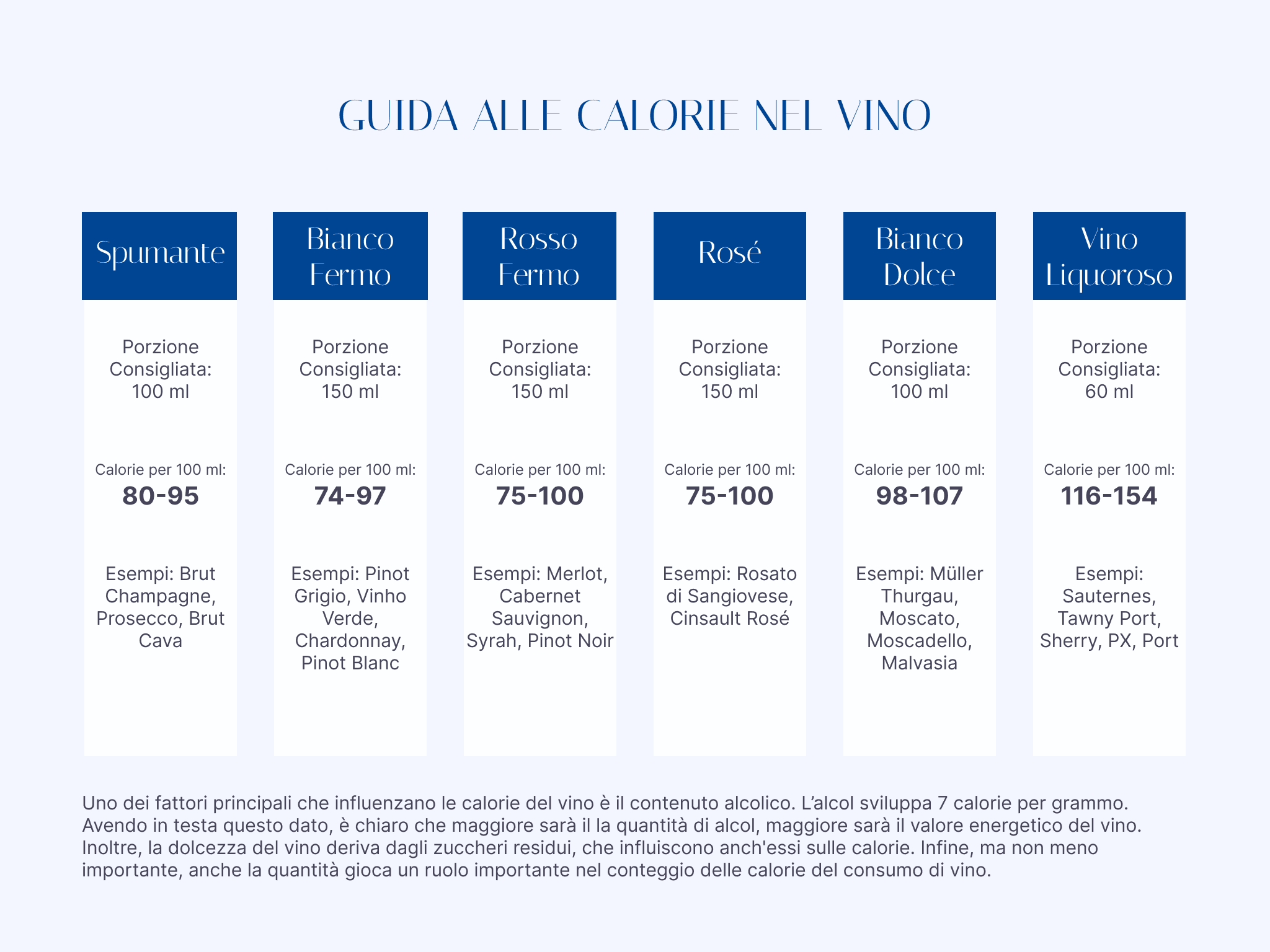
A glass of wine contains between 80 and 150 kcal depending on the type, alcohol content, and residual sugar. Since December 2023, EU Regulation 2021/2117 requires wineries to declare these energy values on every bottle sold in the European Union. For a complete overview of all mandatory label elements, see our wine e-label masterguide.
This guide covers wine calorie ranges by type and the official EU energy calculation method for producers. For legal advice specific to your situation, consult a qualified wine law professional. Last updated: March 2026.
Calorie Reference Table by Wine Type
The table below shows average energy values per 150 ml glass and per 100 ml (the unit required on EU labels):
| Wine Type | Typical ABV | kcal per 150 ml | kcal per 100 ml |
|---|---|---|---|
| Light white (Muscadet, Vinho Verde) | 9–11% | 80–100 | 53–67 |
| Dry white (Sauvignon Blanc, Pinot Grigio) | 11–13% | 100–115 | 67–77 |
| Rosé | 11–13% | 100–115 | 67–77 |
| Dry red (Pinot Noir, Merlot) | 12–14% | 110–130 | 73–87 |
| Full-bodied red (Cabernet Sauvignon, Shiraz) | 13.5–15% | 125–150 | 83–100 |
| Brut sparkling (Prosecco, Champagne) | 11–12.5% | 90–110 | 60–73 |
| Sweet/dessert wine (Sauternes, Port) | 14–20% | 150–250 | 100–167 |
The primary driver is alcohol, which provides 7 kcal per gram — nearly twice the 4 kcal per gram from sugar. This is why a full-bodied 15% ABV red has significantly more calories than a light 10% white, even when both are bone-dry.
The EU Energy Calculation Formula
EU wine labels must display energy values per 100 ml. The calculation accounts for four components:
Energy (kcal/100 ml) = (alcohol g × 7) + (sugar g × 4) + (glycerol g × 2.4) + (organic acids g × 3)
Where:
- Alcohol (g/100 ml) = ABV% × 0.789 (density of ethanol)
- Sugar (g/100 ml) = residual sugar from lab analysis or technical data sheet
- Glycerol (g/100 ml) = typically around 10 g/L for red wines and 5 g/L for whites (AWRI survey data), higher for botrytised wines. Glycerol is a polyol (10 kJ/g), not a carbohydrate, which is why it uses the 2.4 kcal/g factor rather than 4.
- Organic acids (g/100 ml) = total acidity expressed as tartaric acid
To convert to kilojoules: multiply kcal by 4.184.
Worked Example: Typical Chianti Classico
A Chianti Classico with 13.5% ABV, 2.5 g/L residual sugar, 7 g/L glycerol, and 5.5 g/L total acidity:
| Component | g per 100 ml | × factor | kcal |
|---|---|---|---|
| Alcohol | 13.5 × 0.789 = 10.65 | × 7 | 74.6 |
| Sugar | 0.25 | × 4 | 1.0 |
| Glycerol | 0.70 | × 2.4 | 1.7 |
| Organic acids | 0.55 | × 3 | 1.7 |
| Total | 79 kcal/100 ml |
In kilojoules: 79 × 4.184 = 331 kJ/100 ml.
The label would show: E: 331 kJ / 79 kcal (per 100 ml).
Display Requirements: The "E:" Symbol
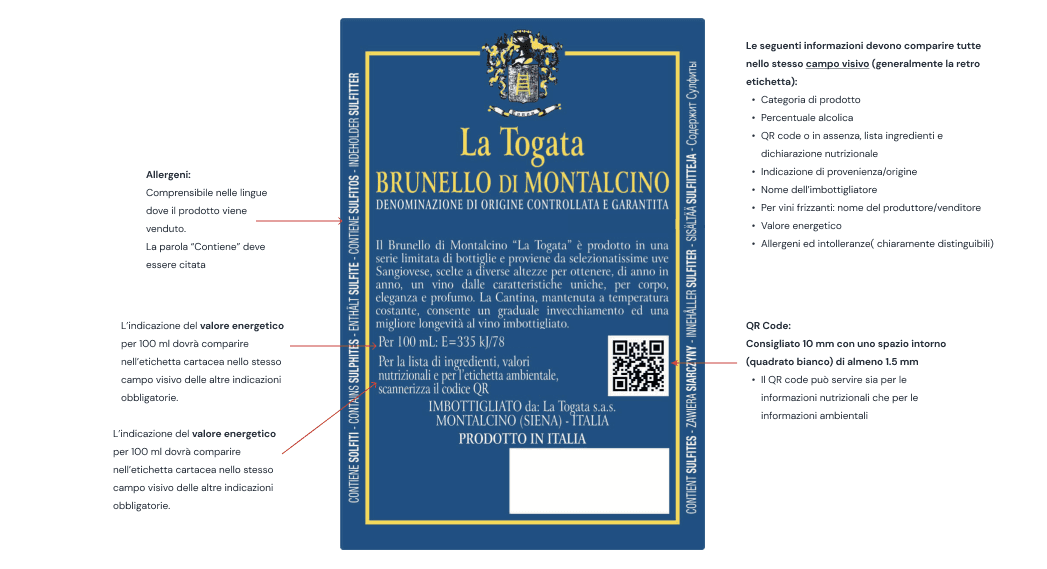
The physical wine label must display the energy value per 100 ml, preceded by "E:" or the word "Energy:" in the language of the market. Both kJ and kcal must be shown. The full nutritional declaration (carbohydrates, sugars, fat, protein, salt) can be provided electronically via a QR code linked to an e-label.
Tolerances: How Much Variation Is Allowed?
Declared energy values do not need to be exact to the last calorie. The EU allows reasonable tolerances to account for natural variation between batches and vintages. Deviations beyond 20% or 20 kcal from the declared value are generally not accepted. For a detailed breakdown of tolerance rules by nutrient, see our guide to tolerance on nutritional values.
This means a single energy calculation can be reused across vintages as long as the wine's core parameters (ABV, residual sugar) remain broadly consistent.
Three Methods to Obtain Energy Data
Wineries can choose from three approaches, depending on the level of precision needed:
Laboratory analysis — the most accurate method. A certified lab measures alcohol, residual sugar, glycerol, and acidity, then calculates the energy value. Recommended for at least the first vintage of each wine.
Formula calculation — use the formula above with known ABV and residual sugar from the technical data sheet. Accurate enough for most dry wines where glycerol and organic acid values fall within typical ranges.
Generally accepted reference data — for wines that match a well-defined type (e.g. standard Prosecco DOC, typical Chianti DOCG), published reference values can be used. Less precise, but acceptable under the regulation.
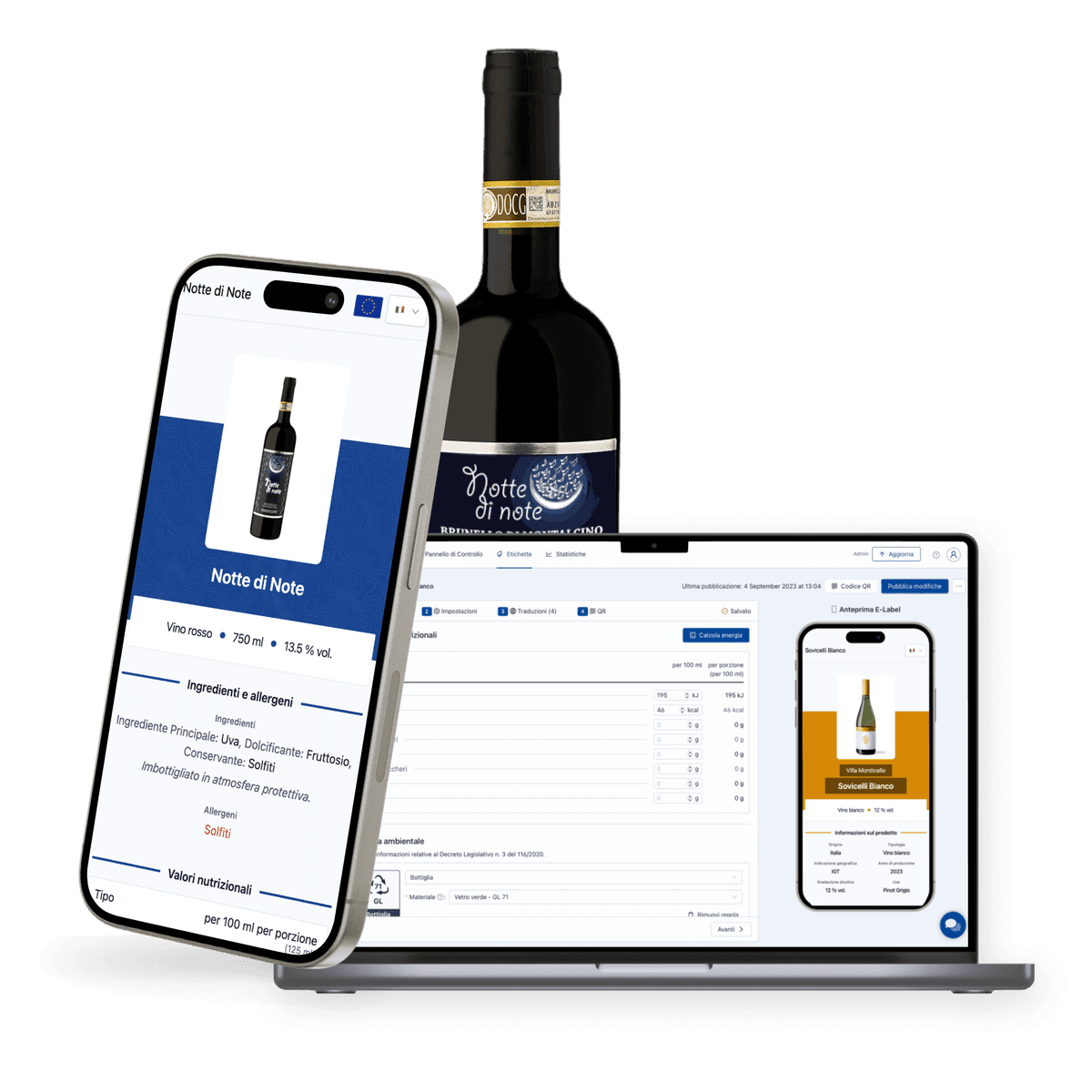
QRFox.eu E-Labels supports all three approaches. Enter your alcohol, sugar, acidity, and glycerol values — or let the system estimate glycerol from the ABV — and the built-in calculator produces EU-compliant energy values in kJ and kcal per 100 ml, ready to display on your e-label via QR code.
How QRFox.eu Automates Energy Calculation
QRFox.eu provides a built-in energy calculator that takes four inputs — alcohol content, residual sugar, organic acids, and glycerol — and outputs the energy value in both kJ and kcal per 100 ml, formatted for EU compliance. When glycerol data is not available from lab analysis, the calculator estimates it automatically. The result is included in your wine's e-label, accessible to consumers via the QR code on the bottle.
This eliminates manual calculation errors and ensures that every e-label displays accurate, regulation-compliant nutritional data. Once calculated, the values carry over to future vintages as long as the wine's core composition stays within tolerance limits.
Ready to get started? Create your first compliant e-label free — no credit card required.